
Under-Eye Fat Repositioning: What It Fixes and What It Cannot
Moving bulging orbital fat into the tear trough smooths a shadowed contour — but it does not erase pigment-driven dark circles.
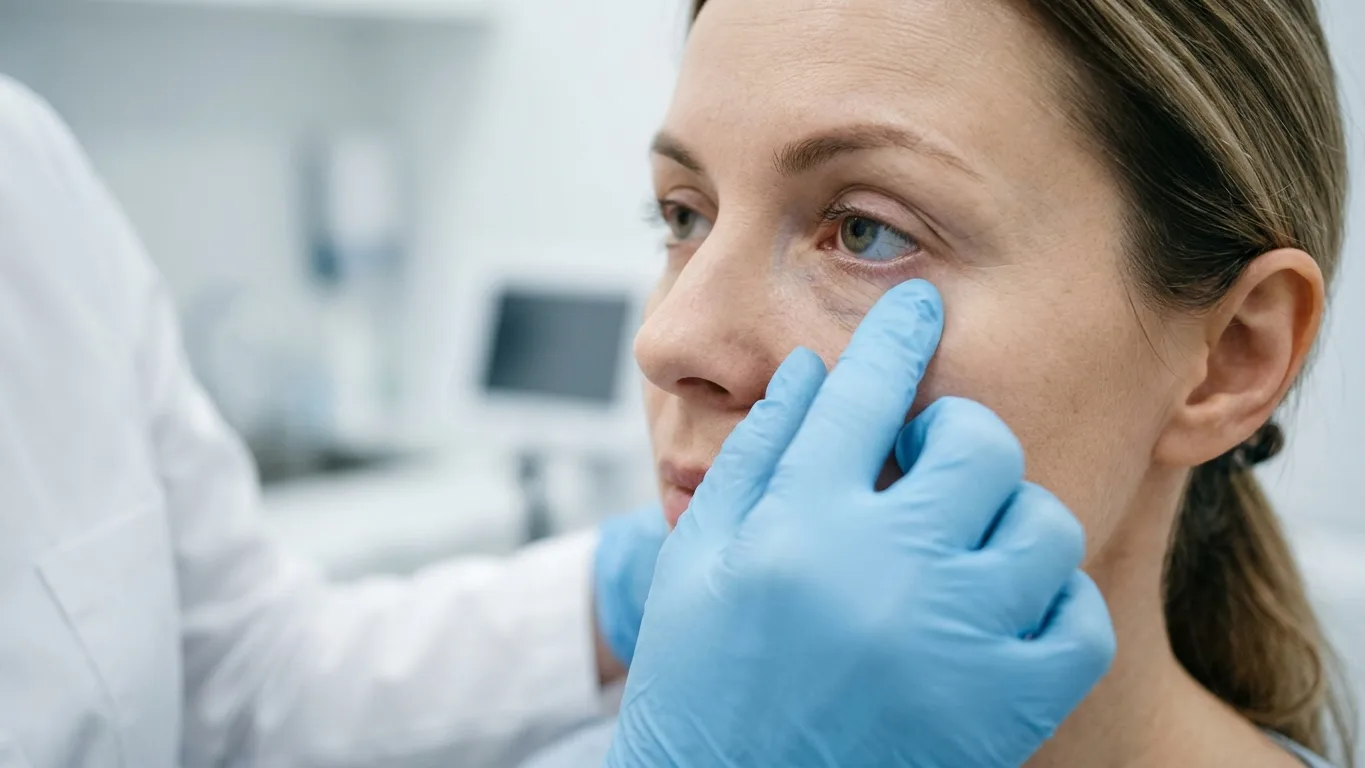
Bags under the eyes form when the fat that cushions the eyeball pushes forward against a weakened supporting wall, creating a bulge with a groove — the tear trough — beneath it. Overhead lighting turns that step in the surface into a shadow, which many people read as dark circles.
Fat repositioning, often performed through the inside of the lower lid, moves that protruding fat down into the groove instead of removing it. The approach has become a common answer for younger patients with resilient skin, but its benefits are specific — and narrower than marketing sometimes implies.
What the operation actually changes
Repositioning addresses contour: the bulge flattens and the trough fills, so the lid-cheek junction reads as one smooth plane. Because the shadow was created by that step, shadow-type darkness typically softens along with it.
Working through the inner surface of the lid leaves no external skin wound, and preserving the fat avoids the hollow look that older removal-only surgery sometimes produced. When loose skin or muscle laxity coexists, surgeons may combine the work with a lower blepharoplasty that handles skin from the outside.
What it cannot do
Dark circles have several causes, and fat repositioning treats only one of them. Brown discoloration from melanin and purple-blue show-through from vessels under thin skin sit in the skin itself, so they remain after the contour is corrected and may call for lasers, topical care or fillers instead.
The procedure also does not tighten skin, lift the midface or stop aging, and fine wrinkles can look more visible once the bulge that stretched them is gone. Sorting shadow from pigment — sometimes as simple as watching the darkness change under different lighting — is the crux of a good evaluation.
Recovery and deciding well
Bruising and swelling generally ease over one to two weeks, though the recovery period varies and the final contour takes longer to settle. As with any eyelid operation there is a possibility of side effects, including temporary lid retraction, contour irregularity, prolonged swelling and, uncommonly, the need for a touch-up procedure.
Because anatomy, skin quality and the cause of darkness differ widely, individual variation in results is substantial. A board-certified specialist consultation that examines the lower lids in animation and under light from several angles is the sound basis for deciding whether repositioning, skin treatment or both fit a given face.
Before your consultation
- Compare your dark circles by a window and under overhead light — shadow shifts, pigment stays.
- Gently press the bulge upward in a mirror; if the darkness fades, contour is a major factor.
- Bring photos from your 20s to show how your lower lids have changed.
- Ask whether your skin quality calls for repositioning alone or combined skin work.
- Confirm the expected recovery period and which symptoms should prompt an early call.
MediIndex articles are for general information only and are not medical advice, diagnosis, or advertising. Outcomes vary by individual — consult a board-certified specialist for personal decisions.